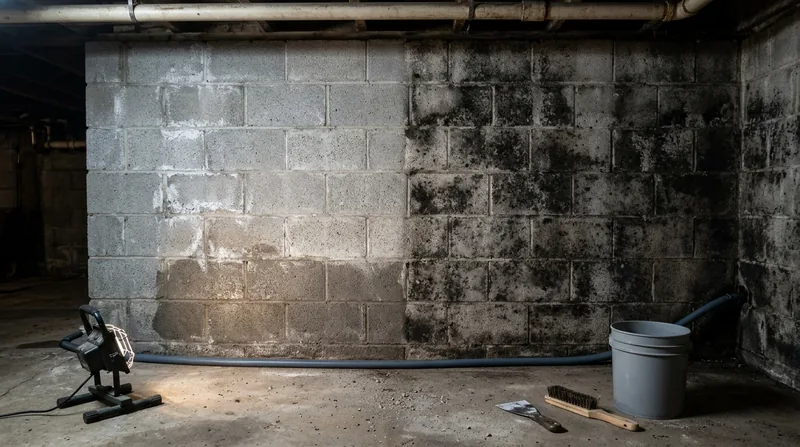




If you smell that damp, earthy odor every time you walk down the steps, you are dealing with a moisture problem that has already turned into mold. Basement Mold Remediation in Greensboro starts with finding the water source, not just scrubbing the walls. Our local housing stock makes this a common call: 1920s brick and stone basements in College Hill and Fisher Park, 1950s block walls in Starmount and Latham Park, and poured-concrete walkouts in Summerfield and Oak Ridge all sit in red Piedmont clay that holds water against the foundation. Add our long humid summers and the occasional hurricane remnant, and a small seep turns into a musty, spotted basement fast. We remove the mold, dry the structure, and fix the moisture path so it does not come back. Start with a free basement inspection and we will tell you exactly what is wet and why.
Why Basement Mold Keeps Coming Back in Greensboro Homes
Mold needs three things: food (paper-faced drywall, wood framing, cardboard boxes), warmth, and moisture. Greensboro supplies the warmth for six months and the moisture all year. The clay soil here swells when wet and shrinks when dry, so the soil pressure against old stone and block walls cycles constantly. That opens hairline cracks, pulls apart old clay footing drains, and pushes water through the wall as hydrostatic pressure. The mold is a symptom. The water is the problem.
- Old clay tile footing drains in Fisher Park and Irving Park clog with roots and silt, so water sits against the footing instead of draining away.
- Brick and block foundation walls wick groundwater upward, which shows up as white efflorescence and dark mold staining near the floor line.
- Downspouts that dump within two feet of the foundation send roof water straight into the same clay that is already saturated.
- Partially finished lower levels in Starmount and Westerwood trap humidity behind paneling and carpet, so mold grows out of sight.
- Poured walkout basements on the rolling lots in Jamestown and Hamilton Lakes collect downhill runoff at the rear wall.
Every one of those paths is fixable, but only after we identify which one is actually feeding the mold.
Key info: A basement in Pleasant Garden that smells musty after every July thunderstorm usually has a saturated footing drain, not a surface mold problem. Treating the visible mold without restoring drainage means it returns within one humid season.
For the official local view on moisture and mold in housing, the City of Greensboro Planning Department and Guilford County building officials are the right starting point on permits and code questions.
How We Run Basement Mold Remediation in Greensboro, Step by Step
We do not fog a basement and call it done. The process starts with moisture mapping: a pin meter on the walls and framing, a hygrometer for relative humidity, and a camera check of the sump basin and drain tile outlets. Then we contain the work area with plastic and negative air pressure so spores do not migrate into the living space above. Only after the moisture source is confirmed do we treat the mold and correct the water path.
- We inspect and map moisture across the walls, floor, joists, and any finished assemblies to find the actual source.
- We set up containment and HEPA filtration so disturbed spores stay inside the work zone.
- We remove porous materials that cannot be cleaned, such as soaked drywall, insulation, and carpet.
- We treat affected framing and masonry with an antimicrobial and physically scrub the surfaces.
- We dry the structure with commercial dehumidifiers and air movers until readings return to normal.
- We correct the water path with drain tile, crack injection, wall sealing, or grading as the inspection dictates.
- We verify with a final moisture reading and a visual clearance check before we pull containment.
If the inspection shows the water is coming through the wall rather than the floor, we move to basement wall sealing or crack injection rather than a full perimeter drain.
Key info: A 1950s brick ranch in Starmount had mold along the bottom two feet of a paneled wall. The cause was a failed sump pump check valve that let discharge water run back into the basin. We replaced the pump and valve, removed the paneling, treated the framing, and dried the room in four days.
Remediation and Moisture Control Methods We Use
Not every mold job needs the same tools. The table below shows the approaches we use most in Greensboro and when each one fits.
| Approach | Description | Best for |
|---|---|---|
| Containment and HEPA remediation | Sealed plastic barriers, negative air pressure, HEPA scrubbers, and surface treatment of framing and masonry. | Visible mold on walls, joists, or stored contents in a finished or semi-finished basement. |
| Moisture source correction | Crack injection, wall sealing, drain tile repair, or grading changes to stop water entry. | Mold that returns after cleaning because water is still entering the basement. |
| Dehumidification and ventilation | Commercial-grade dehumidifiers and controlled air exchange to hold basement humidity in check. | Humid summers in Greensboro where condensation and damp air drive mold growth. |
| Sump and drainage restoration | Sump pump service, check valve replacement, discharge line correction, and interior perimeter drain work. | Basements where water pools on the floor or the pump runs constantly. |
| Material removal and rebuild prep | Removal of unsalvageable drywall, insulation, and carpet, leaving framing clean and ready to close. | Long-term leaks that have soaked porous assemblies beyond cleaning. |
We recommend the least invasive method that actually solves the moisture problem, and we say so plainly when a simple crack seal is enough.
Basement Mold Remediation Cost in Greensboro: What to Expect
Most basement mold remediation projects in Greensboro start around $1,500 for a contained area with a straightforward moisture fix, and climb from there. The price is driven by square footage affected, how much porous material has to come out, whether the basement is finished, and what waterproofing work is needed to stop the water. A single damp wall behind paneling is a very different job from a fully finished lower level with mold behind the drywall on three sides.
We quote the remediation and the moisture correction separately so you can see what each part costs. Getting two or three estimates is smart, and we encourage you to compare scope, not just the bottom line. Ask each contractor whether containment and drying are included, and whether the water source fix is part of the price. Our full pricing overview breaks down the ranges we see across the metro.
Basement Mold Remediation Near Me: How to Pick a Contractor Near Greensboro
Mold work and waterproofing overlap, and you want a contractor who understands both. A company that only scrubs surfaces will leave you with the same problem next summer. Ask direct questions before you sign anything.
- Confirm the company is licensed and insured, and ask for a certificate of insurance before work begins.
- Get at least two or three written estimates that itemize remediation and moisture correction separately.
- Ask for local references from Greensboro, High Point, or Summerfield jobs similar in age and foundation type to your home.
- Ask whether the work requires a permit from the City of Greensboro or Guilford County, since structural and drainage changes often do.
- Check whether your neighborhood or HOA has rules about exterior drainage changes, discharge locations, or visible equipment.
If a contractor cannot explain how the water is getting in, keep looking. You can contact us for a straight answer and a free inspection.
When to Call Us
If you smell mustiness, see dark staining or white efflorescence on the walls, or notice mold returning after a cleaning, the moisture source is still active. We serve Greensboro and the surrounding communities, and we will tell you honestly whether you need full remediation or a simpler drainage fix. Call (336) 203-7271 to schedule your free basement inspection.
Basement Mold Remediation in Greensboro: Pricing Guide
| Service | Price | Details |
|---|---|---|
| Contained mold treatment | Starting at $1,500 | Includes containment, HEPA filtration, surface treatment, and drying for a limited area with a simple moisture fix. |
| Finished basement remediation | Starting at $3,200 | Covers removal of affected drywall and insulation, framing treatment, and drying across a larger finished area. |
| Remediation plus drainage correction | Starting at $4,500 | Combines mold removal with drain tile repair, crack injection, or sump work to stop the water source. |
| Complex or large-scale job | On estimate | Full lower-level remediation with structural moisture repairs needs an on-site inspection before we quote a number. |
| Travel | Included | In Greensboro and surrounding areas, with no separate call-out or mileage fee. |
| Estimate | Free | Response within 24 hours at (336) 203-7271, with no obligation to book. |
Indicative pricing, the exact cost depends on square footage, finish, and site access. Free personalized estimate within 24h at (336) 203-7271.


