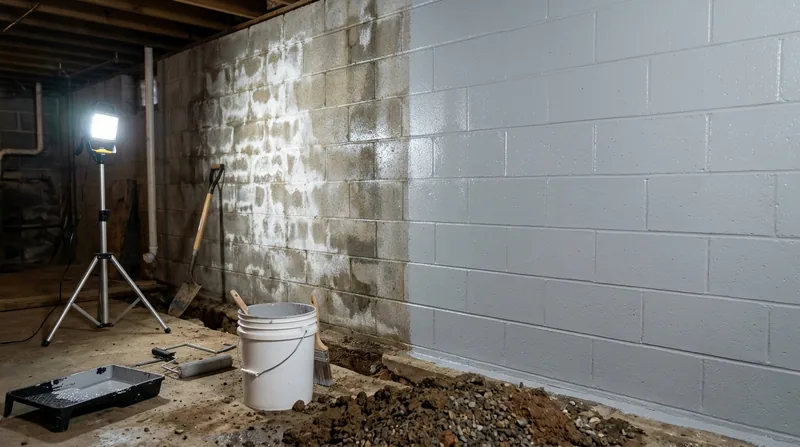




Why Basement Wall Sealing Matters in Greensboro
Basement Wall Sealing in Greensboro is the first line of defense for the many stone, brick, and block foundations that sit on red Piedmont clay across Fisher Park, Irving Park, and College Hill. That clay swells when it soaks up summer thunderstorm downpours and shrinks in dry spells, flexing the walls and opening hairline cracks that let dampness bleed through. In older homes the original clay footing drains are often crushed or silted shut, so water stacks up against the wall instead of running away. Sealing the wall stops surface seepage and stops efflorescence from returning, but it does not fix hydrostatic pressure. We tell you which problem you actually have before we quote a sealer. For the full picture of what happens below grade, see our basement waterproofing service.
Why Greensboro Basements Leak: Clay, Old Drains, and Storm Runoff
The dominant failure mode here is not a single crack. It is water stacking up against a wall because the footing drain is dead and the clay will not drain fast enough after a storm. Homes in Starmount and Latham Park with partly finished lower levels often show white efflorescence and a musty smell long before anyone sees standing water. Newer walkout basements in Summerfield and Oak Ridge leak at the cold joint where the poured wall meets the footing, especially after a freeze-thaw night. Sealing addresses the damp wall surface, but only after we confirm the drain and grading are doing their job.
- Efflorescence on block walls signals moisture moving through the masonry, not just a surface stain.
- Hairline cracks in poured walls seep after heavy rain and need epoxy or polyurethane injection, not just a sealer.
- Crushed clay footing drains in pre-1950 homes let water pool against the foundation.
- Downspouts dumping within two feet of the wall push roof water straight into the clay.
- Hydrostatic pressure from a rising water table after Buffalo or Reedy Fork creek floods requires drainage, not paint.
We test for moisture and pressure first, then recommend the sealer only when the wall is damp but not under load.
Key info: A 1920s brick Colonial in College Hill with white powder on the wall and a damp smell usually needs efflorescence removal plus a penetrating sealer, while a 1990s walkout in Hamilton Lakes with water at the cold joint needs injection and drainage work first.
Permits and code questions for foundation work are handled by the City of Greensboro building department, and rules vary by jurisdiction, so confirm before any structural repair. You can check local permit guidance at Greensboro Permits and Inspections.
How We Seal Basement Walls in Greensboro
We start with a free inspection that maps the moisture, not just the stain. We check the wall surface, the cold joint, the footing drain if it is accessible, and the grading around the house. Then we prep the wall, remove efflorescence, and apply the right sealer for the wall type. On older brick and stone we use a breathable penetrating sealer so the masonry can dry. On poured walls we use a membrane where the wall is damp but stable.
- We inspect the wall, the footing, and the grading, and we photograph the moisture pattern.
- We remove efflorescence and loose parging with a wire brush and a masonry cleaner.
- We fill hairline cracks with epoxy or polyurethane injection when the crack is active.
- We apply a penetrating sealer on brick and block, or a waterproof membrane on poured walls.
- We extend downspouts and correct grading so water runs away from the wall.
- We recheck the wall after the next rain and confirm the sealer is holding.
If the inspection shows hydrostatic pressure or a dead footing drain, we say so and point you to an interior drain tile system instead of selling you a sealer that will fail.
Key info: On a 1950s brick ranch in Westerwood, we removed efflorescence, injected two hairline cracks, and applied a breathable sealer. The wall stayed dry through the next summer thunderstorm season because we also extended the downspouts.
Sealing Methods We Use and When Each One Fits
The right method depends on the wall material, the moisture source, and whether the wall is moving. Here is how we match the approach to the problem.
| Approach | Description | Best for |
|---|---|---|
| Penetrating sealer | Soaks into brick and block and blocks capillary moisture while letting the wall breathe. | Damp brick and block walls with efflorescence but no standing water. |
| Waterproof membrane | A flexible coating that bridges hairline cracks and seals the wall surface. | Poured concrete walls with surface seepage and stable cracks. |
| Epoxy injection | Ports are set along the crack and epoxy is pumped in to bond the concrete back together. | Non-moving structural cracks in poured walls. |
| Polyurethane injection | Foam expands into the crack and seals active leaks, even in wet conditions. | Active leaks and cracks that move with the clay. |
We choose the method after the inspection, not before, because a sealer on a pressured wall is money wasted.
Basement Wall Sealing Cost in Greensboro: What to Expect
Most basement wall sealing jobs in Greensboro start around $1,500 for a standard wall with efflorescence removal and a penetrating sealer. The price climbs when the wall needs crack injection, when access is tight, or when the wall is large and the prep takes longer. A walkout basement in Summerfield with a long poured wall costs more than a partial basement in College Hill. We quote after the inspection so the number reflects the wall you have.
Get two or three estimates and compare what is included, not just the bottom line. A low bid that skips efflorescence removal or crack injection will not hold. Our pricing page lays out the ranges so you can compare fairly.
What to Look For in a Basement Wall Sealing Contractor Near Greensboro
Hiring the right contractor matters more than the sealer brand. Ask for proof of license and insurance, and get a written scope that names the prep steps and the sealer. Check references from homes with the same wall type and age as yours. Confirm whether the work needs a permit, since structural repairs and drainage changes often do, and ask how the contractor handles any HOA rules on exterior work. A contractor who explains why a sealer will not fix hydrostatic pressure is the one to trust.
Call us at (336) 203-7271 or use the contact page to schedule a free inspection. We serve Greensboro and the surrounding towns, and we tell you plainly when sealing is enough and when it is not.
Basement Wall Sealing in Greensboro: Pricing Guide
| Service | Price | Details |
|---|---|---|
| Penetrating sealer on brick or block wall | Starting at $1,500 | Includes efflorescence removal, masonry cleaner, and one coat of breathable sealer on a standard wall. |
| Waterproof membrane on poured wall | Starting at $2,200 | Includes surface prep and membrane application; price rises with wall length and crack count. |
| Crack injection plus sealing | Starting at $1,900 | Includes epoxy or polyurethane injection on active cracks before the sealer goes on. |
| Complex or large-scale job | On estimate | Long walkout walls, heavy efflorescence, or tight access need an on-site look first. |
| Travel | Included | In Greensboro and surrounding areas, with no separate call-out or mileage fee. |
| Estimate | Free | Response within 24 hours at (336) 203-7271, with no obligation to book. |
Indicative pricing, the exact cost depends on square footage, finish, and site access. Free personalized estimate within 24h at (336) 203-7271.


