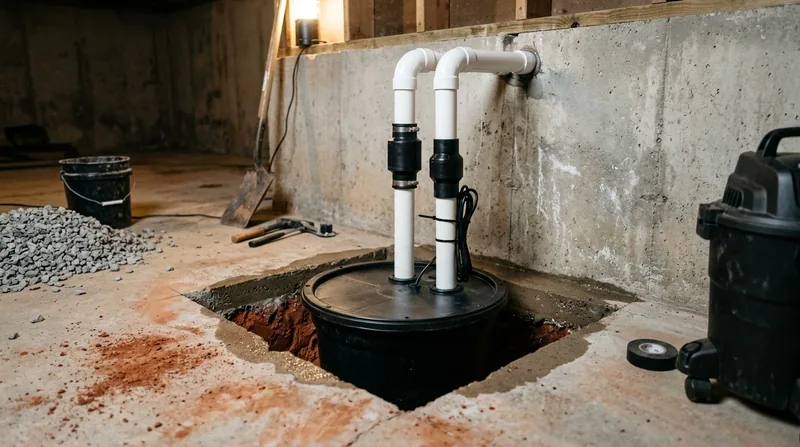




Sump Pump Installation & Replacement in Greensboro
When you need Sump Pump Installation & Replacement in Greensboro, you need a pump that keeps up with red Piedmont clay, a rising water table, and the kind of summer downpour that dumps two inches in an hour. Our crews work the older stone and brick basements in Fisher Park and College Hill, the finished lower levels of 1950s brick ranches in Starmount and Latham Park, and the poured-concrete walkouts on the rolling lots out toward Summerfield and Oak Ridge. Buffalo and Reedy Fork creeks back up into low neighborhoods during hurricane remnants, and that is when a tired pump or a short-cycled basin shows its hand. We size the pump to the actual inflow, seal the basin, set a check valve, and route the discharge so water leaves the foundation instead of looping back to it. If your basin is dry one week and overwhelmed the next, start with a free basement inspection so we can measure what the pump really faces.
Why Sump Pump Work Matters So Much in Greensboro's Clay and Older Basements
Greensboro sits on red clay over decomposed granite. That clay swells when it is wet and shrinks when it dries, and it does not drain quickly, so storm water piles up against the footing and pushes inward as hydrostatic pressure. In the 1900s to 1930s homes around Irving Park and Lindley Park, the original clay footing drains are often crushed or silted shut, which leaves the sump basin doing all the work. In the 1940s to 1960s split-levels across Westerwood, the lower level is partly finished, so a failed pump soaks drywall and carpet before anyone notices. The pump is the last line of defense, and it has to be matched to the inflow, not picked off a shelf.
- We measure the actual inflow rate during wet weather instead of guessing from basement square footage.
- We set a sealed basin lid so groundwater vapor and odors stay out of the living space above.
- We install a check valve and a discharge line that carries water well past the foundation and downhill.
- We test the float switch through several full cycles before we call the job finished.
Getting the pump, basin, and discharge right the first time is what keeps a wet basement from becoming a recurring spring problem.
Key info: A home near Hamilton Lakes with a finished walkout lower level had a 1/3 HP pump that ran almost continuously during a July thunderstorm and tripped its thermal overload. We upsized to a 1/2 HP cast-iron pump, enlarged the basin, and extended the discharge 12 feet downhill. The pump now cycles in short bursts instead of running hot.
For official guidance on plumbing and drainage permits, check the City of Greensboro's permit pages at greensboro-nc.gov before any discharge line is altered.
How We Install or Replace a Sump Pump in Greensboro, Step by Step
Every job starts with the water, not the hardware. We watch how the basin fills, check the drain tile entering it, and look for efflorescence or seepage on the walls that tells us whether the pump alone is enough or whether the real fix is an interior drain tile system. Then we build the pit, set the pump, and route the discharge to a point that will not send water back against the house.
- We inspect the basin, the incoming drain tile, and the wall seepage pattern to confirm the pump is the right fix.
- We dig or enlarge the sump basin to fit the pump and give it enough reserve volume for a heavy storm.
- We set the pump on a solid base, install the check valve, and plumb a rigid discharge line with a freeze-resistant slope.
- We route the discharge to daylight, a dry well, or an approved storm connection, never just a few feet from the foundation.
- We fill the basin and cycle the pump repeatedly to confirm the float, the check valve, and the discharge all work together.
The result is a system that handles Greensboro's storm pattern without short-cycling or burning out the motor.
Key info: A 1960s brick ranch in Starmount had its discharge line running into a bed of mulch six feet from the wall. Every storm sent that water straight back to the footing. We extended the line to a pop-up emitter 15 feet downhill, and the basement stayed dry through the next tropical remnant.
Sump Pump Approaches We Use in Greensboro Homes
Not every basement needs the same setup. A stone-foundation colonial in College Hill behaves differently from a poured-concrete walkout in Summerfield, and the pump, basin, and backup strategy should follow the building. Here is how the main approaches compare.
| Approach | Description | Best for |
|---|---|---|
| Primary pump replacement | Swap a failed or undersized pump in an existing basin with a correctly sized cast-iron unit. | Basins that are sound but the pump has aged out or short-cycles. |
| New basin and pump install | Cut and set a new sealed sump basin with a pump sized to the measured inflow. | Older homes with no basin or a shallow, open pit that overflows. |
| Discharge line correction | Reroute the discharge to daylight or a dry well with proper slope and a check valve. | Pumps that run constantly because water loops back to the foundation. |
| Battery backup addition | Add a battery backup pump to cover power loss during storms. | Finished lower levels where a power outage means water on the floor. |
| Pump plus drain tile integration | Tie a new pump into an interior perimeter drain when wall seepage is the source. | Basements where hydrostatic pressure, not just the basin, is the problem. |
We match the approach to the building and the water, not to a one-size package.
Sump Pump Installation & Replacement Cost in Greensboro: What to Expect
Most sump pump installations in Greensboro start from $1,200, and that figure reflects a straightforward replacement in an existing basin with a correctly sized pump and a working discharge line. The number moves up when the job needs a new basin cut into a slab, a longer discharge run to daylight, a battery backup, or integration with an interior drain tile system. Older homes in Fisher Park or Irving Park with stone and brick foundations can take more labor to open and seal a basin than a poured wall in Summerfield. Access matters too: a finished lower level means moving furniture and protecting flooring before we cut. Get two or three written estimates and compare what is actually included, not just the bottom line. Our full pricing overview lays out the ranges in more detail.
What to Look For When Hiring a Sump Pump Contractor Near Me in Greensboro
Ask for proof of licensure and insurance before anyone touches your basement, and get the certificate sent to you, not just a verbal yes. Ask how the contractor sizes the pump: if the answer is square footage alone, keep looking, because inflow rate is what matters. Ask whether the discharge will be routed away from the foundation and whether the basin will be sealed. Check references from Greensboro jobs with similar foundations, and confirm who pulls any permit required for altering drainage or the sanitary connection of the discharge. If your home is in a neighborhood with architectural review or HOA rules, confirm the discharge point is allowed before work starts. You can reach us through the contact page to schedule a look.
Sump Pump Installation & Replacement Near Me: What Greensboro Homeowners Should Know
If you are searching for a sump pump contractor near me in Greensboro, the practical question is whether the pump can keep up with the water your lot actually receives. Homes on the flat ground toward Gibsonville and Whitsett are often slab-on-grade with no basement, but the older neighborhoods and the rolling lots west toward Jamestown and Oak Ridge have real below-grade space that depends on a working pump. We serve those areas and the rest of the metro, and we tell you plainly when a simple replacement is enough and when the water is telling you the basin and drain tile need attention. Call (336) 203-7271 and we will schedule a free inspection.
Sump Pump Installation & Replacement in Greensboro: Pricing Guide
| Service | Price | Details |
|---|---|---|
| Sump pump replacement (existing basin) | Starting at $1,200 | Includes correctly sized cast-iron pump, check valve, and discharge line test in a sound existing basin. |
| New sump basin and pump installation | Starting at $1,850 | Includes cutting and setting a sealed basin plus pump sized to measured inflow, higher for slab or stone walls. |
| Discharge line correction | Starting at $650 | Includes rerouting the discharge to daylight or a dry well with proper slope; longer runs cost more. |
| Battery backup pump addition | Starting at $750 | Includes backup pump, battery, and charger installed alongside the primary pump. |
| Pump plus interior drain tile integration | On estimate | Requires an on-site look at wall seepage and drain tile condition before a number is given. |
| Estimate | Free | Response within 24 hours at (336) 203-7271, no obligation to book. |
Indicative pricing, the exact cost depends on square footage, finish, and site access. Free personalized estimate within 24h at (336) 203-7271.


