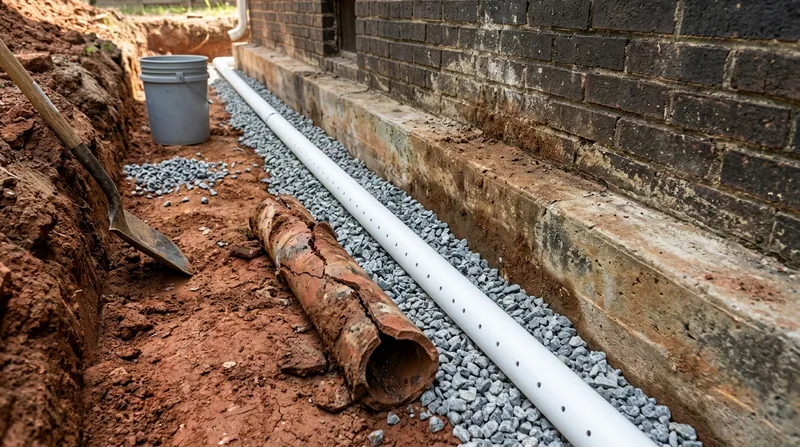




Drain Tile Repair & Replacement in Greensboro: When the Old Clay Tile Finally Gives Out
If you own a 1920s Colonial Revival in Fisher Park or a 1950s brick ranch in Starmount, there is a good chance the footing drain around your foundation is original clay tile, and there is an even better chance it stopped moving water decades ago. Drain Tile Repair & Replacement in Greensboro is the work of finding that failed line, getting water away from the footing again, and stopping the wet basement cycle before it reaches the finished lower level. The ground here is red Piedmont clay over decomposed granite, and it swells hard when wet and shrinks when dry, which is exactly the kind of movement that shears old tile joints and lets roots find the gaps. We handle the camera inspection, the targeted excavation, and the PVC replacement, and we tell you plainly when a repair is enough and when the line needs to be replaced. If you are still sorting out whether the problem is the drain tile or the wall itself, start with a free basement inspection so the diagnosis is based on what is actually under the slab and along the footing.
Why Drain Tile Repair Matters So Much in Greensboro's Older Basements
Greensboro sits on clay that holds water against the foundation long after the rain stops, and the neighborhoods with the oldest housing stock have the oldest drains. Homes in College Hill, Irving Park, and Lindley Park were built with clay or brick footing drains that were never meant to last a century, and many now sit with crushed sections, root intrusion, and settled low spots that trap water instead of carrying it to daylight or a sump. When that line fails, hydrostatic pressure builds under the slab and the water finds the path of least resistance, usually a cold joint, a tie rod hole, or the cove where the wall meets the floor.
- Original clay tile collapses at the joints and silts up, so it stops draining even when it is still physically in place.
- Tree roots from mature oaks and maples in older yards enter through hairline cracks and choke the line within a few seasons.
- Piedmont clay soil moves with wet and dry cycles, which shifts the tile grade and creates low spots that hold water.
- Downspouts and grading that dump runoff near the foundation overload a drain that was already undersized.
- Homes on the rolling lots in Summerfield and Oak Ridge often have a daylight discharge that gets buried or blocked, backing water up under the footing.
Any one of these is enough to produce a wet basement after a summer thunderstorm, and most older Greensboro homes have two or three working at once.
Key info: A 1930s Tudor in Lindley Park with a stone foundation and original clay tile is a very different repair than a 1990s walkout in Hamilton Lakes with a plastic footing drain that was crushed during a patio pour. We camera both, but only one usually needs full replacement.
For the official word on what requires a permit when drainage or the sump discharge connection is altered, check with the City of Greensboro building department at greensboro-nc.gov, since thresholds change and the local office has the final say.
How We Diagnose and Replace a Failed Drain Tile Line in Greensboro
We do not start digging until we know where the line runs, where it is broken, and where the water is supposed to end up. On a typical Greensboro job we push a camera through the existing tile from the sump basin or the cleanout, map the run, and mark the failures on the surface. Then we choose the least invasive path that actually solves the problem, which is sometimes a spot repair and sometimes a full replacement around the perimeter.
- We camera the existing line and locate collapses, root balls, and silt blockages, then mark them above grade.
- We check the discharge point, whether it is a daylight outfall, a sump basin, or a connection to the storm system, and confirm it is not the real bottleneck.
- We excavate only the failed sections where a spot repair makes sense, or open the full perimeter when the tile is deteriorated throughout.
- We bed new perforated PVC in washed stone and filter fabric so clay and roots stay out of the pipe.
- We re-grade the run so it falls continuously to the discharge, then test it with water before backfilling.
- We restore the surface and walk you through what we found so you understand what failed and why.
On a 1960s split-level in Westerwood, that often means replacing a short run along the uphill wall where the clay tile had settled, not tearing up the whole perimeter. On a 1920s home in Fisher Park with tile that is broken in six places, replacement is the honest answer.
Key info: In Summerfield and Oak Ridge, where walkout basements sit on sloped lots, the drain tile often daylights downhill and the failure is a crushed or buried outfall rather than the tile itself. We check the outfall first because it is the cheapest fix when it is the culprit.
When the drain tile is beyond saving and the water is already pressing under the slab, an interior drain tile system is often the more reliable long-term answer than excavating the exterior of a mature landscaped yard.
Repair and Replacement Approaches We Use in Greensboro
Not every failed drain tile needs the same treatment, and the right approach depends on the age of the line, the foundation type, and how the water needs to leave the property. Here is how the options compare on Greensboro homes.
| Approach | Description | Best for |
|---|---|---|
| Targeted spot repair | Excavate and replace only the collapsed or root-bound section, then reconnect to the sound tile on either side. | One or two isolated failures in an otherwise flowing line, common on 1950s and 1960s ranches. |
| Full exterior footing drain replacement | Replace the entire perimeter run with perforated PVC bedded in washed stone and filter fabric. | Original clay tile deteriorated throughout, typical of 1900s to 1930s homes in Fisher Park and College Hill. |
| Interior perimeter drain retrofit | Cut a channel along the interior footing, install drain tile to a sump basin, and discharge with a pump. | Finished basements, mature landscaping, or when exterior excavation is impractical. |
| Outfall and discharge repair | Clear, re-route, or rebuild a buried or crushed daylight discharge so the line can actually empty. | Sloped lots in Summerfield, Oak Ridge, and Jamestown where the tile itself is still sound. |
| Sump basin and pump upgrade | Replace a failed or undersized basin and pump so the repaired drain has somewhere to send water. | Homes where the drain works but the pump cannot keep up during a summer downpour. |
Drain Tile Repair & Replacement Cost in Greensboro: What to Expect
Most drain tile work we see in Greensboro starts at From $750 for a targeted spot repair, and climbs from there based on how much of the line is actually failed. The biggest cost drivers are the length of the run, whether the excavation is exterior or interior, the depth of the footing, access for equipment, and whether the discharge point needs to be rebuilt. A single collapsed section on a ranch in Starmount is a very different number than a full perimeter replacement around a stone foundation in Irving Park.
We always recommend getting two or three written estimates on the same scope, because a cheap number that only patches one broken section will not fix a line that is failing in four places. Ask each contractor to show you the camera footage and to explain why they are recommending repair versus replacement. Our full breakdown of what moves the number is on the pricing page, and we are happy to walk you through it before you commit to anything.
Drain Tile Repair & Replacement Near Me: How to Choose a Contractor Near Greensboro
Hiring for drain tile work is mostly about verifying three things: that the contractor is licensed and insured, that they will show you the camera footage instead of just quoting a number, and that they understand what permits your project triggers. Ask for a certificate of insurance before work starts, call two recent references in Greensboro, and confirm who pulls the permit if the job alters drainage or the sump discharge connection.
Be wary of anyone who quotes a full replacement without running a camera, and equally wary of a contractor who wants to seal cracks in the wall when the real problem is a failed footing drain. Those are different jobs, and the wrong one wastes money. If your property is in a neighborhood with HOA rules about excavation, grading, or discharge location, get that in writing before the crew mobilizes. When you are ready to talk through your situation, contact us and we will set up a time to look at the line.
Drain Tile Repair & Replacement in Greensboro: Pricing Guide
| Service | Price | Details |
|---|---|---|
| Targeted spot repair | Starting at $750 | Includes camera inspection, excavation of one failed section, and PVC splice reconnected to sound tile |
| Interior perimeter drain retrofit | Starting at $2,800 | Includes channel cut along interior footing, new drain tile, and connection to sump basin |
| Full exterior footing drain replacement | On estimate | Priced per linear foot after camera and site review, since depth and access vary widely |
| Outfall and discharge repair | Starting at $950 | Includes locating, clearing, or rebuilding a buried or crushed daylight discharge line |
| Travel | Included | In Greensboro and surrounding areas, no separate call-out or mileage fee |
| Estimate | Free | Response within 24h at (336) 203-7271, no obligation to book |
Indicative pricing, the exact cost depends on square footage, finish, and site access. Free personalized estimate within 24h at (336) 203-7271.


