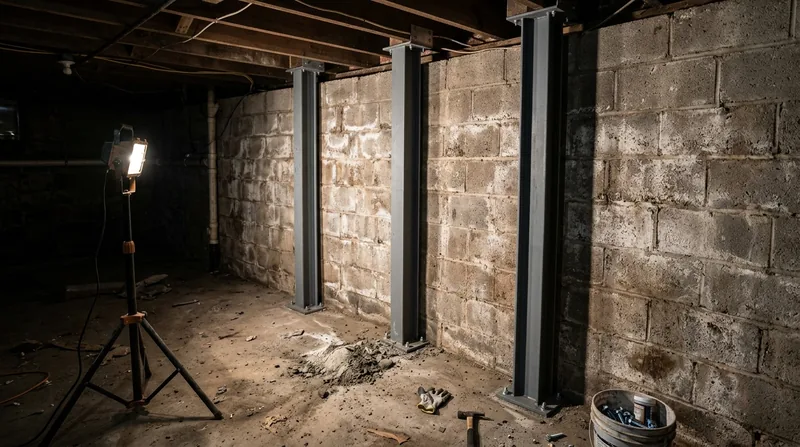




Bowing Wall Repair in Greensboro starts with reading the ground, not the wall. Piedmont red clay over decomposed granite swells every wet season and shrinks every dry one, and it pushes hard against the block, brick and stone basement walls under Fisher Park, Irving Park, College Hill and Lindley Park. After a summer downpour or a hurricane remnant, that saturated clay backfill loads older walls until they lean inward at the top and crack along the mortar joints. We stabilize that movement with carbon fiber straps, steel I-beams or wall anchors, matched to how far the wall has moved and what the soil is doing. If your wall is already telling you something, start with a free basement inspection before the movement gets worse.
Why Bowing Walls Are a Greensboro Problem, Not a Cosmetic One
Greensboro sits on some of the most active clay in the Southeast, and the housing stock sits right on top of it. The 1900s to 1930s homes around College Hill and Lindley Park were built with stone and brick foundations and old clay footing drains that have long since collapsed or silted shut. When the footing drain stops working, water sits against the wall and the clay backfill stays saturated instead of draining away.
- Hydrostatic pressure builds behind the wall and pushes the middle of the wall inward.
- Clay backfill expands when wet and does not shrink back fast enough to release the load.
- Old clay weeping tile clogs, so water never reaches the original drain path.
- Mortar joints crack and stair-step, which is the first visible sign of movement.
- Freeze-thaw nights in January and February open those cracks wider.
Ignoring a bowing wall does not make it stop moving, and the repair only gets more involved once the wall has shifted further.
Key info: A 1920s brick basement wall in Irving Park that leans two inches at the top is a different repair from a poured wall in Summerfield that has cracked but not moved. We measure the deflection before we recommend anything.
Structural repair of this kind is permitted work in most jurisdictions, and the City of Greensboro handles building permits through its development services department. Rules vary, so confirm the current requirement with the local building department before work starts. You can review the city's permit information at greensboro-nc.gov.
How We Diagnose and Stabilize a Bowing Wall in Greensboro
Every repair starts with the question of why the wall moved. We check the wall for plumb, map the cracks, look for efflorescence and water staining, and test whether water is still reaching the backfill. If the wall is dry and the movement is minor, crack sealing and monitoring may be all you need. If saturated clay is still pressing on the wall, stabilizing the wall without fixing the water source just delays the next problem.
- We measure the horizontal deflection at the top, middle and bottom of the wall.
- We inspect the footing drain and the grading around the foundation to find where water is entering.
- We determine whether the wall is bowing from soil pressure or settling from below.
- We match the method to the severity: carbon fiber straps for minor to moderate bowing, steel I-beams for heavier loads, wall anchors where the wall can be pulled back.
- We address the water source so the repair holds, often with an interior drain tile system that relieves pressure at the footing.
Once the wall is stabilized and the water is managed, the repair has something to hold onto.
Key info: On a split-level in Starmount, a block wall had bowed about an inch and a half over twenty years. Carbon fiber straps on the inside face stopped the movement, and a new interior perimeter drain took the water off the footing. No exterior excavation was needed.
Repair Methods We Use and When Each One Fits
The right method depends on how far the wall has moved, what the wall is made of, and how much soil pressure is still active. We do not sell one system to every house.
| Approach | Description | Best for |
|---|---|---|
| Carbon fiber straps | Straps bonded to the inside face and anchored top and bottom to stop further inward movement. | Minor to moderate bowing on block and poured walls. |
| Steel I-beams | Vertical steel beams set against the wall and tied into the floor and joists. | Heavier loads and walls with significant deflection. |
| Wall anchors | Plates on the outside of the wall tied to anchors in stable soil, used to pull the wall back. | Walls that can still be straightened without excavation. |
| Crack injection and sealing | Epoxy or polyurethane injection to close cracks and stop water at the crack itself. | Hairline and shrinkage cracks with no active movement. |
We confirm the method after the inspection, not before, because the wall and the soil decide the answer.
Bowing Wall Repair Cost in Greensboro: What to Expect
Bowing wall repair is priced by the linear foot of wall and by the method, so a single-wall job on a small ranch in Westerwood is not the same as a full basement in Oak Ridge. As a starting point, minor crack injection and sealing begins around $600. Carbon fiber strapping, steel beams and wall anchors run higher because they involve engineered materials and more labor. The full breakdown lives on our pricing page.
- How far the wall has moved and how many walls are affected.
- Wall material: stone and brick take more prep than poured concrete.
- Access to the wall, especially in finished lower levels.
- Whether the water source has to be corrected at the same time.
- Permit requirements for structural work in your jurisdiction.
Get two or three written estimates and compare what each one actually includes, not just the bottom line.
Choosing a Bowing Wall Repair Contractor Near Me in Greensboro
Ask for proof of licensing and insurance before anyone touches the wall, and get a certificate of insurance sent directly from the carrier. Ask how many bowing walls the company has stabilized in Guilford County and what method they used. Confirm who pulls the permit and whether the scope includes correcting the water source. If a bid promises a fix without inspecting the wall, keep looking. Reach us through the contact page to set up an inspection.
For homeowners in High Point or Jamestown, the same clay and the same older block walls apply, and our High Point service page covers the local conditions in more detail.
Bowing Wall Repair in Greensboro: Pricing Guide
| Service | Price | Details |
|---|---|---|
| Crack injection and sealing | Starting at $600 | Covers epoxy or polyurethane injection on accessible cracks, with wall length and crack count moving the price. |
| Carbon fiber strap installation | Starting at $1,200 | Straps bonded and anchored to stop movement, priced per strap and by wall height and access. |
| Steel I-beam stabilization | Starting at $2,400 | Engineered beams tied into floor and joists, priced by beam count and load severity. |
| Wall anchor system | Starting at $3,500 | Exterior anchor plates and rods used to pull the wall back, priced by wall length and soil conditions. |
| On-site structural assessment | Free | We measure deflection and inspect the footing drain before recommending any method, no obligation. |
| Travel | Included | In Greensboro and surrounding areas, no separate call-out or mileage fee. |
Indicative pricing, the exact cost depends on square footage, finish, and site access. Free personalized estimate within 24h at (336) 203-7271.


