The Soil Under Your Greensboro Home Is Not Passive
Most homeowners think of the ground beneath their house as a stable, unchanging base. In the Greensboro area, that assumption is wrong. Guilford County sits in the heart of the North Carolina Piedmont, and the soil profile here is a layered challenge: a heavy red clay topsoil sitting over decomposed granite and saprolite. Each layer behaves differently when water enters the picture, and that difference is exactly why so many basements and crawl spaces in this region end up wet.
The red clay is the first culprit. It is dense, sticky, and loaded with fine particles that swell when wet and shrink when dry. Under a foundation, that constant cycle of expansion and contraction creates pressure against your basement walls and movement beneath your footings. The decomposed granite below is more granular and drains differently, sometimes holding water like a sponge and sometimes letting it move quickly. When these two materials interact with seasonal rainfall, the result is a slow, relentless push of water toward your foundation.
Clay Shrink-Swell: The Quiet Cause of Foundation Cracks
The phrase clay shrink-swell sounds technical, but the concept is simple. Red Piedmont clay absorbs water and expands. During a dry North Carolina summer, it loses that water and contracts. This cycle happens year after year, and your foundation feels every inch of it. The soil pushes inward against basement walls when saturated and pulls away when dry, leaving gaps where water can pour in during the next storm. Those gaps are one of the most common reasons we get called for Foundation Waterproofing in this region.
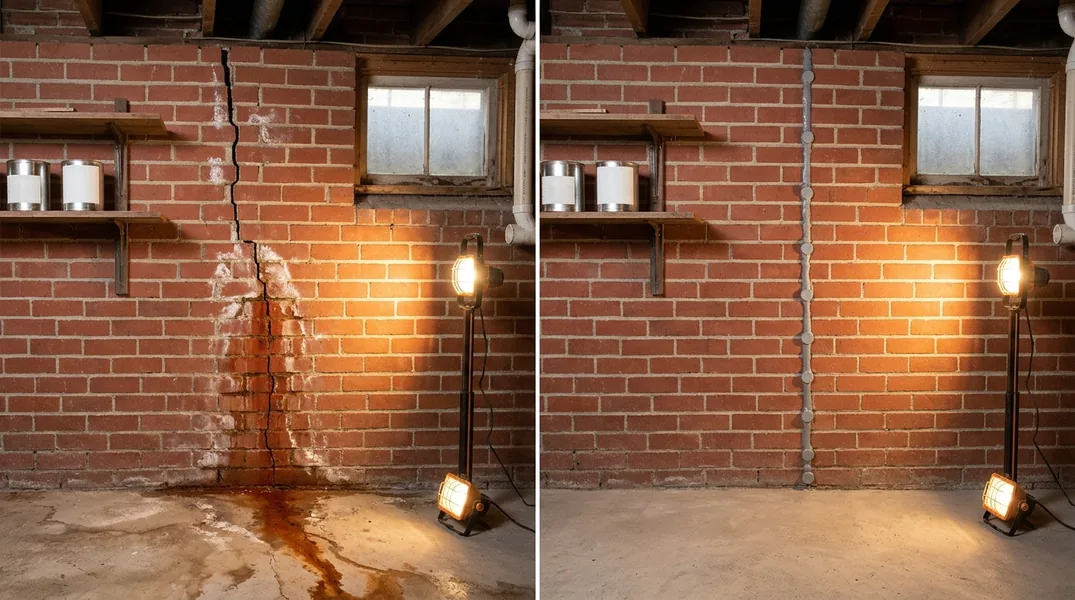
Over time, this movement produces the hairline cracks and stair-step cracks that homeowners discover in block walls and poured concrete. A crack that looks minor in October can become a steady leak path by February. It is not unusual for us to find cracks that have been opening and closing for a decade, each cycle widening them just a little more. If you have noticed new cracks, efflorescence (the white powder on basement walls), or damp spots after heavy rain, the soil is likely already doing its work. The earlier you address it, the less structural damage you face.
Why Piedmont Soil Basement Leaks Show Up in High Point and Summerfield Too
The same geology runs across the region, which is why we see identical patterns in High Point and Summerfield. Homes built on sloped lots are especially vulnerable because water running downhill hits the foundation and has nowhere to go but in. Properties near Jamestown often deal with the added complication of older construction where original drainage systems have long since failed. The soil does not care about property lines or zip codes; it behaves the same way everywhere the red clay and decomposed granite meet.
What changes from home to home is how the water actually enters. Some basements take on water at the cove joint where the floor meets the wall. Others leak through cracks, window wells, or porous block. Crawl spaces often stay damp because water vapor rises from the soil and condenses on cool framing. This is why a one-size-fits-all approach fails. A proper diagnosis looks at grade, gutter discharge, soil type, and the foundation itself before anyone recommends a solution.
Basement Waterproofing Near Me: Matching the Fix to the Soil
When homeowners search for basement waterproofing near me, they usually want a straightforward answer: stop the water. The honest answer is that the right fix depends on where the water is coming from. For many homes here, an Interior Drain Tile System is the most reliable option. It captures water at the cove joint and under the floor before it can rise into your living space, and it works regardless of how saturated the clay outside becomes. Interior systems are also easier to install without destroying landscaping.
In other cases, especially where the goal is to keep water out of the soil entirely, Exterior Basement Waterproofing is the better long-term investment. This involves excavating down to the footing, applying a waterproof membrane, and installing drainage that redirects water away from the foundation. For homes with significant clay pressure or repeated leaks, exterior work addresses the root cause rather than managing the symptom. A thorough inspection tells you which path makes sense for your property and your budget.
Basement Waterproofing Cost in Greensboro: What to Budget
Homeowners researching pricing deserve realistic numbers, not vague promises. In the Greensboro market, interior drain tile systems typically fall in a moderate range depending on linear footage and whether a sump pump is included. Exterior waterproofing costs more because it involves excavation and membrane work, but it often solves problems that interior systems can only manage. Crack injection and minor repairs sit at the lower end, while full-perimeter projects with multiple water entry points sit at the higher end.
The most useful step you can take is to get a written scope of work that explains what is being fixed and why. A quote that lists materials, labor, and the specific water path being addressed is worth more than a low number with no detail. We are happy to walk you through options and provide a free estimate so you can compare apples to apples. If you prefer to talk it through first, call (336) 203-7271 and we will help you understand what your home actually needs.
Protecting Your Foundation Before the Next Wet Season
You cannot change the soil under your house, but you can change how water interacts with it. Start with the simple things: keep gutters clean, extend downspouts at least six to eight feet from the foundation, and make sure the ground slopes away from the house rather than toward it. These steps reduce the volume of water that reaches the clay in the first place. They are not a substitute for Basement Waterproofing, but they make any system work better and last longer.
If you have already seen water, cracks, or dampness, the best move is a professional inspection before the next heavy rain season. The clay and decomposed granite under Guilford County are not going to become less aggressive, and small problems here tend to grow quietly. Greensboro Waterproofing serves homeowners across the area and can identify exactly where the water is coming from and what it will take to keep your basement dry. Reach out today and get a clear plan for protecting your foundation.
Looking for a professional basement waterproofing contractor in Greensboro? Greensboro Waterproofing responds fast for all your basement waterproofing needs.
Get a Free QuoteOur services: Basement Waterproofing · Interior Drain Tile System · Exterior Basement Waterproofing